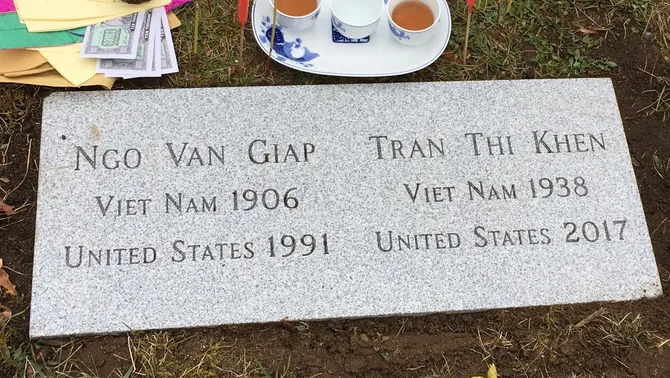
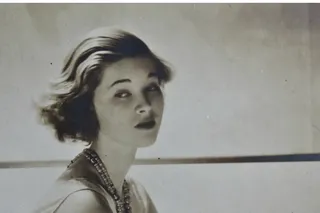
Hanoi to Harlem to Fifth Avenue: Giap, the Chef Who Raised Me
Our household and the kitchen Giap cooked in was in many ways a strange microcosm of the latter half of the twentieth century: its wars, migrations, divided countries and unlikely blend of people and cultures.
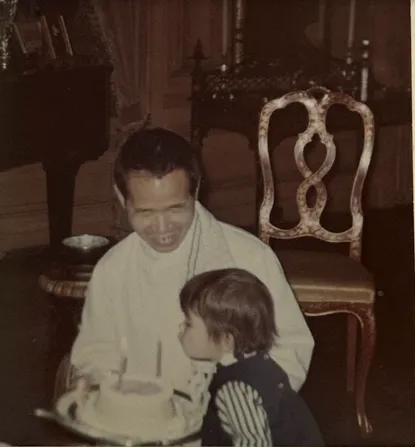
My earliest memories of Giap Ngo Van are of sitting on the floor of his room in our Manhattan apartment, watching his hands.
I was five, perhaps younger. He would squat on the floor, rolling cigarettes. He smoked filterless Winstons when he wasn’t rolling his own, and for reasons that seem almost incomprehensible to me now, he taught me how to roll them too. Sometimes he even let me smoke.
I didn’t inhale. I knew enough to understand that much.
Khen, my Vietnamese nanny, whose room was across the hall, did not approve.
I can still hear her anger.
I was a little afraid of Giap. He was stern, and to a small child he seemed enormous in the way certain adults do, even though he was tiny and thin. But I loved him. In fact, I spent more time with him when I was young than I did with my father. He talked with a stutter that was frightening but also endearing.
Nobody ever gave me a whooping like Giap did. It wasn’t often, but it was something. I remember the imprint his hand could leave on my ass.
I knew even then that there was something in Giap’s past that I could not understand. He had been beaten badly as a child. He was orphaned when he was young and, as the story was told to me, kept in a cage. One day, a Frenchman saw him there and bought him from the people who had him. That is how he got to France.
It sounds like something from a novel.
While he could be stern, he could also be extraordinarily tender. I felt that tenderness most clearly in his food.
He knew my favorite things to eat, and he made them for me. Every birthday, there was chocolate soufflé. There was asparagus with hollandaise. There was consommé with tapioca, which I called “bump soup.”
Those dishes were his way of loving me.
Giap was our chef, but that doesn’t quite describe his place in my childhood. He and Khen occupied a small constellation of rooms in our apartment that, in my memory, belonged to another world. Their rooms, the kitchen and the laundry room were our territory. It was a white, practical world of pressed linen, hot irons, laundry steaming and the smells of broths simmering on the stove.
Two doors away was my parents’ world.
That world was darker and more elaborate. Dark burgundy Fortuny fabric covered the walls. There was old mercury glass, antiques, a library, drinks before dinner, and the formal rituals of entertaining. My father and mother might have guests for dinner in the dining room when they weren’t out on the town themselves, or when home alone, they would have meals carried to them on trays in into their bedroom. I rarely dined with them except for Sunday lunch and on special occasions.
I moved between the two worlds.
Every evening, I carried trays of hors d’oeuvres at exactly 6pm from the kitchen into the library, where my parents and their friends drank before dinner. I knew how to cross that threshold, even if I didn’t quite understand the difference between the worlds on either side.
In the kitchen, Giap cooked.
For my parents and their friends, he made French food: elegant dishes that suited the ornately painted china, vintage Bordeaux wines, and formal dining. There were lobster bisques and the unmistakable fragrance of tarragon, followed by mains like Tournedos Rossini, filet mignon topped with seared foie gras and black truffle, served over a crisp crouton with a rich Madeira sauce.
For the three of us, there was Vietnamese food. I ate dinner at quarter past 6 in the kitchen, with Khen and Giap.
When my little brother came along, there was macaroni and salami.
I grew up thinking this was perfectly normal.
Most dinners began with soup. Giap was a great lover of soup, and I think it was through him that I first understood that food could be more than something you ate because you were hungry.
Food was an offering. It had memory. It could make you feel that you belonged somewhere.
At the time, I didn’t have words for any of this. I only knew that the kitchen was where I wanted to be.
I knew the smell of star anise before I knew what star anise was. I knew the difference between the smells coming from a French stew and a Vietnamese phở. I knew that Giap’s hands could turn a collection of ingredients into something that made the whole apartment feel different.
When I was little, I used to pretend that I was Khen and Giap’s daughter.
They had an apartment of their own downtown, in the projects, on East 17th Street. During the week, they lived with us, but on weekends, or when my parents were away, I sometimes went with them to their apartment. I loved going there.
There were so many languages, so many nationalities, people coming from places I knew little about. I loved the energy of it. The sounds, the smells, the aliveness.
My favorite thing was playing boule with Giap and the old men in the park nearby. I would play alongside them, listening to conversations I didn’t understand, completely at home. I dreaded going back uptown to our apartment, where so much of life was formal and measured.
I knew Giap had worked in restaurants before coming to our family. I knew he had friends at the United Nations who asked him to cook for special parties and delegations. And that he was known for his food expertise, often consulting on restaurant projects.
But I didn't know why.
It would take me decades to understand that the man sitting on the floor of his room, impatiently showing a five-year-old girl how to roll a cigarette, had been part of a much larger story.
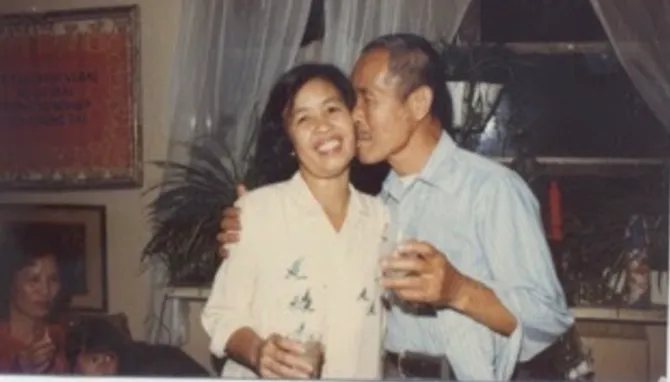
It wasn't until November 2024, almost fifty years after Giap left our kitchen, that I began to understand who he had really been.
It began, unexpectedly, with Khen.
On November 14, 2024, I received an email from Minh-Ha Pham, a professor and food historian researching the early Vietnamese food scene in New York, before the 1980s. She had come across news stories about Thi Khen Tran and had learned that Khen had spent several years in New York in the late 1960s and early 1970s with our family.
She wanted to talk to me about her.
At that point, I had no idea that my memories of Khen would lead into the much larger story of Giap.
Minh-Ha was researching something that, until then, I hadn’t even realized was missing from the history of American food: the Vietnamese community that existed in the United States before 1975, before the fall of Saigon and the great wave of Vietnamese refugees who would later transform American food culture.
The story most American historians had believed was that Vietnamese food in America began in California, with the Vietnamese refugees who arrived after the war. But Minh-Ha’s research revealed something quite different. There had been an earlier Vietnamese presence in America, centered not in California but in New York and Washington, D.C., where Vietnamese students, diplomats, professionals, domestic workers and others were already cooking, eating and sharing their food decades before 1975.
Her questions sent me back into my own childhood. I began asking my older sisters questions I had never thought to ask before. Memories that had been scattered for decades began to connect. There were things I remembered about Giap, things my sisters remembered, things I had heard as a child but never understood, and then there was Minh-Ha’s painstaking research.
Piece by piece, the story of Giap began to come back into focus.
That research eventually became a published article, “A Story as Old as Cha Gio,” in Gastronomica, the academic journal devoted to food studies, in the spring of 2026.
For me, it was an extraordinary experience to see someone else researching people who had simply been part of my childhood.
Minh-Ha was looking at Khen and Giap as part of the history of Vietnamese food in America.
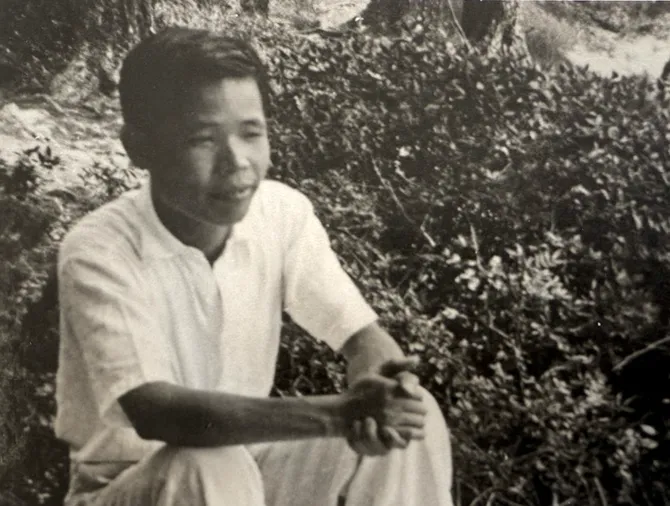
The First Vietnamese Restaurant in America
Before Giap came to our family, he had already been part of something remarkable.
In 1961, he was the head chef at Viet Nam Restaurant, at 1245 Amsterdam Avenue near 122nd Street in Harlem. It was the first Vietnamese restaurant in the United States, opening nearly a decade before San Francisco’s Cordon Bleu, a Vietnamese restaurant with a distinctly French-sounding name, which opened in 1970.
And Giap wasn’t simply cooking phở in some tiny restaurant for a handful of Vietnamese customers.
He was cooking for New York.
Viet Nam Restaurant was reviewed by Craig Claiborne in The New York Times on August 15, 1961. Claiborne, the paper’s first food editor, described the restaurant as attracting people of many nationalities and singled out the menu for its “admirable variety.”
That original menu fascinates me now.
It was not a Vietnamese restaurant menu I might have expected to find in America in 1961. There was phở, of course, but there was also chả giò, the crisp rice-paper rolls that would eventually become one of the best-known Vietnamese dishes in America; thịt nướng, smoked and grilled beef; chạo tôm, ground shrimp formed around sugarcane; and tôm rim, shrimp braised with pork.
There was Four-Style Beef, four different preparations of beef served as one course.
There was crab meat à la Hanoienne. Giap loved cooking crab.
There was steamed fish named for the Perfume River in Huế.
And the restaurant’s advertisements went further, promoting “Paris renowned” phở, Saigon-style bì bún and Hanoi-style bánh cuốn. The chả giò was advertised as a first-prize winner at an international food contest in Tokyo.
I love that menu because it tells us something about Giap.
He wasn’t just making Northern Vietnamese food, the food of the region he came from. The menu revealed the culinary life he had lived and the several worlds he had crossed before he ever entered our kitchen.
Giap had lived in Paris. There he cooked for Richard Wheatland II, an American naval officer and government official working under the Marshall Plan. Wheatland had served during World War II aboard the USS Harry F. Bauer alongside my father, who was also a naval officer aboard the destroyer-minelayer. They fought together in the Pacific.
The Bauer, dubbed the luckiest ship in the Pacific, had a remarkable war record. During the Battle of Okinawa, the ship came under repeated Japanese air attacks. A kamikaze struck the ship. Later, the crew discovered that a Japanese bomb had penetrated the vessel and lodged in a fuel tank.
It had been there for seventeen days.
Unexploded.
Seventeen days, sitting inside the ship that carried my father and Wheatland through the Pacific war. The bomb was eventually discovered and carefully removed. They were extraordinarily lucky to have survived.
I find myself thinking about that luck now.
My father and Wheatland survived the war. Years later, Wheatland was in Paris under the Marshall Plan, where Giap ended up cooking for his family. Wheatland returned to New York, and he brought Giap with him.
In New York, Wheatland was a vice president of New York Airways, and he got Giap a job as a chef for the airline, where Giap spent several years cooking French food. After that, he went on to be a chef at several restaurants before eventually coming to our family.
Giap’s cooking life carried traces of several places and histories: Vietnam, Paris, and New York. The menu at Viet Nam Restaurant reflected that complexity.
Vietnamese food was not being presented as one thing.
It was Hanoi and Saigon. It was Huế. It was street food and elaborate cooking. It was regional and sophisticated. It carried memories of a diverse and complicated history, of a country divided. And it had hints of Paris.
In 1962, Mademoiselle magazine included Viet Nam Restaurant in its Career Girl’s Guide to New York, calling it a “tiny, immaculate spot” for women sophisticated enough to choose good food over status symbols. A full-course meal was $3.75. An entrée of Ga Kho Sa, braised chicken with ginger and lemongrass, was $2.75. Another recommendation was Thit Heo Nau Nam, described as Imperial meatballs.
Nobody made a meatball like Giap. They were always so soft, light enough to fall apart on the fork. He would fold fresh bread crumbs into the mixture, probably torn from day-old baguettes he’d soaked in fish sauce and shallot oil until they became puffy and dissolved.
A Kitchen Blending Worlds
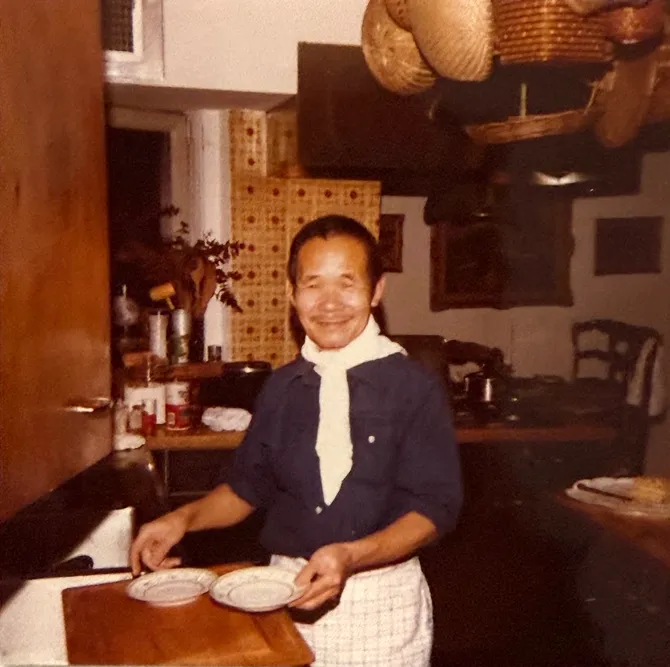
Our household and the kitchen Giap cooked in was in many ways a strange microcosm of the latter half of the twentieth century: its wars, migrations, divided countries, an unlikely blend of people and cultures.
My father was a decorated American naval officer who had fought in the Pacific during World War II. My mother was German. Giap was from North Vietnam. Khen was from South Vietnam and was brought to the USA by a South Vietnamese General as his family's nanny. And I was half Japanese and half German, born on December 7, Pearl Harbor Day.
None of us sat around the kitchen discussing the weight of that history.
We were simply living together.
And yet, looking back, it seems extraordinary. All of us in one apartment on Fifth Avenue.
There were different languages spoken in our household, different pasts carried in from different parts of the world, but there was one thing that seemed to belong to all of us.
Food.
Giap’s food.
Later, Khen learned to cook from Giap, and she became a phenomenal cook in her own right. Some of the most wonderful food stories I have to tell are about Khen and what she went on to create.
But she learned from Giap. What he taught her would stay with her, and eventually find its way to me and, years later, to my own children, through blended recreations.
The food served in our house was like me and my history, never just about being one thing. It was a mix. A blending of history and people, of places and memories, transformed into something new.
When I think of Giap now, I often think of his hands.
When I was eleven, there was a terrible accident in our kitchen. My father had installed a salamander grill high above the counter and Giap had to stand on a stool to reach it. There was a fat tray beneath it to collect the oil drippings. Giap reached up to remove the tray. The oil was beyond hot, and it poured over his hand.
The burns were severe. I remember my father rushing him to Mount Sinai Hospital as he howled in pain as his flesh tore off. After that, his hand was mostly mottled white with scar tissue.
But when I think of his hands now, I see them before the burns.
I see the hands I watched as a little girl, rolling cigarettes on the floor of his room. The same hands that made rice noodles by hand, consommé and chả giò and chocolate soufflés for my birthday.
Perhaps that is what history is. Not only what happened, but where we choose to place ourselves in relation to it. We take the pieces we have been given and carry some of them forward.
And so it is with food. It doesn't erase history. It embodies it, evolving as it passes from one person to another. A time capsule that never quite fills, leaving something new to discover.