A House Full of Imagination: Inside Pedro Friedeberg's Casa Diana
There is something appealing about a gallery that can bring together an artist's legacy, the work of family members, and the discoveries of the present. It feels less like a retrospective and more like an ongoing conversation.
The House That Pedro Built
Inside Casa Diana, where art, architecture and everyday life come together in San Miguel de Allende.
There are certain things in San Miguel de Allende that make you stop and look twice. A doorway painted a color you can't quite name. A courtyard that belongs to another century. A staircase leading somewhere unexpected.
Sometimes, all it takes is a friend who can't resist a splash of color.
Last year, I was walking along Calle Recreo with my friend Mimi, when we came upon a doorway that caught her attention. Mimi is an artist whose own work is filled with glorious color, and she was drawn toward it like a moth to a light. I followed her inside.
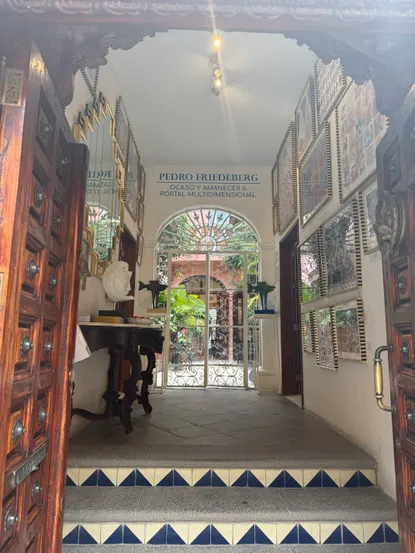
We had stumbled upon Casa Diana, the former home of Pedro Friedeberg, the celebrated surrealist artist who died in March 2026, aged 90. His former wife, Carmen Gutiérrez, still lives there and runs the gallery.
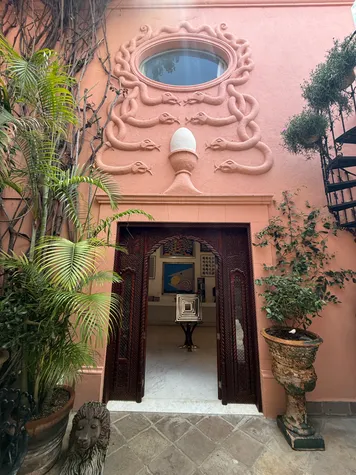
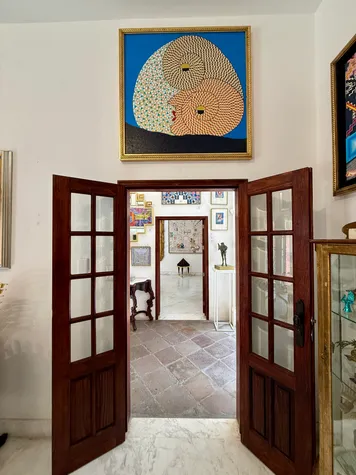
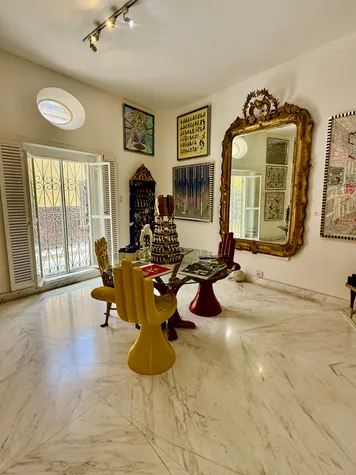
I love places like this, where the distinction between a home and a gallery dissolves. Casa Diana isn't a pristine white cube designed to make you concentrate on the art. It's a lovely house with personality, history, and accumulated eccentricity. And what a house it is.
A House Full of Imagination
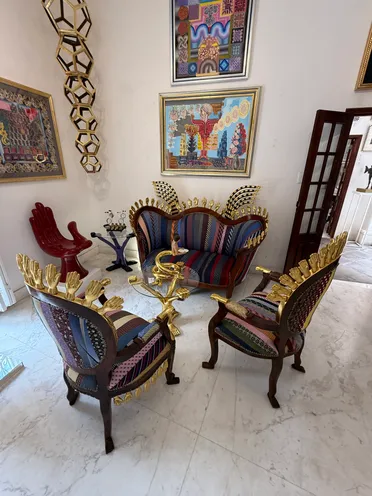
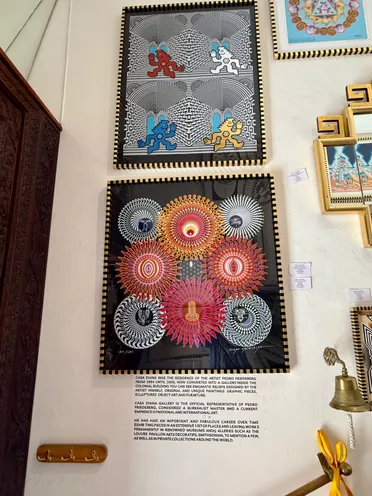
The first thing that strikes you is the sheer abundance of detail. Paintings, sculptures, intricate patterns, and architectural flourishes compete for your attention. Every room seems to offer another surprise.
And then there are the fireplaces
One is dominated by the enormous face of a lion, its open mouth framing the hearth. Elsewhere, sculptural horses transform a functional feature into something altogether more fantastical. The walls are adorned with elaborate reliefs and friezes, making the architecture feel almost alive.
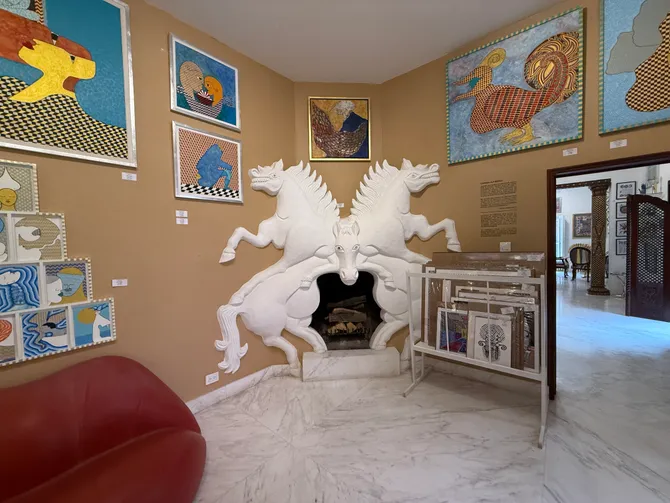
These aren't simply decorative objects placed in a room. They are part of the house itself, woven into its identity.
Pedro Friedeberg was best known internationally for his Hand Chair, the surrealist seat shaped like an enormous human hand. The palm becomes the seat, the fingers the backrest. It is playful, a little absurd, and instantly recognizable.
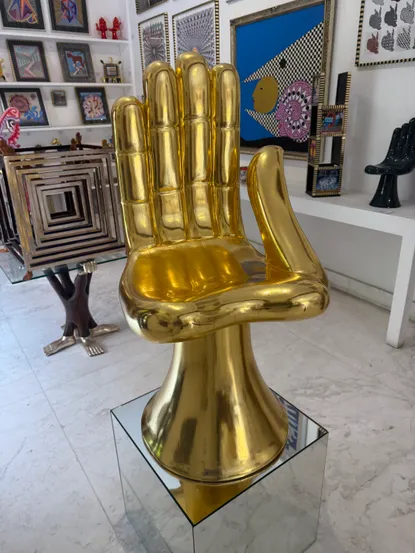
But Casa Diana offers a glimpse of something more intimate than his famous furniture. Here, you begin to understand just how thoroughly his imagination inhabited the spaces around him. Architecture, art, and everyday life were never entirely separate.
A fireplace could become an animal. A wall could become a labyrinth. A house could become a work of art.
An Artist's Imagination, Captured in Miniature
One of the things that particularly captivated me was Pedro's art journal.
There it was, a small book on display, filled with his ideas rendered in miniature. Page after page offered a glimpse into the workings of his imagination: a private world of drawings, patterns, and visual possibilities, all contained within the pages of a book.
We often encounter an artist's finished work, beautifully presented in a gallery or museum, but rarely get such an intimate sense of how ideas begin. A journal offers something different. It lets us look over the artist's shoulder, to see the thoughts and images taking shape before they become something larger.
In Pedro's case, even the smallest drawings seem to contain entire worlds. The intricate geometry, fantastical architecture, and elaborate patterns that define his work are all there, condensed into a series of pages.
It felt like discovering the blueprint to a very unusual mind.
The gallery sells copies of the journal, so you can take a little piece of that imagination home with you. I rather like the idea of carrying around a miniature Friedeberg universe, something to open when the ordinary world feels a little too ordinary, and you need a pop of color and labyrinth of lines.
A Family of Artists
Casa Diana is also a reminder that art rarely exists in isolation. Behind the famous name is a family, a home, and a wider circle of creative people.
Carmen Gutiérrez, Pedro's former wife, is an artist in her own right and has pieces in the gallery. She continues to live in the house and direct the gallery, keeping it alive as a place where art is not merely displayed but remains part of everyday life.
Pedro's work and artistic legacy are central to Casa Diana, particularly in its extraordinary architectural details. But the gallery is not simply a shrine to one artist. It also welcomes other creative voices, including members of the extended family.
During our visit, a niece was showing work. I loved this sense of a creative world that extends beyond one generation or one celebrated name.
There is something appealing about a gallery that can bring together an artist's legacy, the work of family members, and the discoveries of the present. It feels less like a retrospective and more like an ongoing conversation.
The Man Behind the Hand
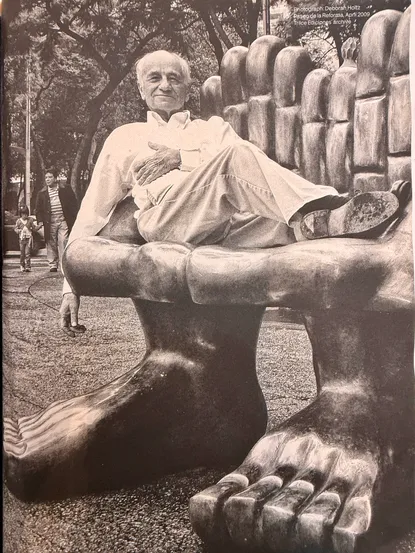
Pedro Friedeberg was born in Florence, Italy, in 1936 and came to Mexico as a child. He studied architecture before turning toward art, eventually becoming one of Mexico's best-known surrealist artists.
His work is difficult to mistake for anyone else's. Filled with intricate geometry, elaborate patterns, fantastical architecture, and an almost obsessive attention to detail, it creates worlds that seem to operate according to their own peculiar logic.
The Hand Chair, created in 1962, became an international design icon. Yet his work extended far beyond that single creation, encompassing paintings, drawings, furniture, and architectural projects.
When Mimi and I visited Casa Diana last year, Pedro was still alive, dividing his time between Mexico City and San Miguel de Allende. We were discovering a place connected to a living artist, even if we hadn't fully appreciated the significance of that connection at the time.
His death inevitably changes the way we think about the house. What was once part of his everyday world now carries the added weight of memory. Yet Casa Diana continues, with Carmen at its heart and art still filling its rooms.
There is something reassuring about that continuity. The work remains, the doors are open, and new generations of visitors can discover the extraordinary world Pedro created.
Casa Diana
Recreo 48, Centro