Machu Picchu: what I wish I'd known before we went
A practical guide to visiting Machu Picchu if you're not doing one of the multi-day hikes. This is how we did it, what I wish I'd known, and what I'd do again.
Machu Picchu really does live up to the hype. But there were quite a few things about getting there that I didn't fully understand until we did it ourselves.
We were staying in Ollantaytambo, in the Sacred Valley, and used it as our base for the round trip to Machu Picchu. I'm really glad we did. We took the train from Ollantaytambo to Machu Picchu Pueblo, also known as Aguas Calientes, and returned to Ollantaytambo afterwards.
The train from Ollantaytambo to Aguas Calientes takes about 1½-2 hours, depending on the service. From Cusco, it's considerably longer. The train from Poroy station is about 3½ hours, while some services from Cusco are a bus-and-train combination and can take around four hours or more.
Aguas Calientes is the little town at the base of Machu Picchu. There are plenty of hotels there if you'd rather stay overnight. You can also travel from Cusco, and some people do Machu Picchu as a day trip. One of the people in our group did it. Chris. It was a long day, but it worked out just fine but then again he is in his twenties and has way more stamina for long days.
Here is the bit I didn't understand: the train does NOT take you to Machu Picchu.
It takes you to Aguas Calientes.
From there, you take a bus for about 30 minutes, climbing a spectacular series of switchbacks up the mountain to the entrance to Machu Picchu. The bus is a separate ticket from both your train and your Machu Picchu entrance.
If you want to do it in style, there is also the Hiram Bingham, A Belmond Train, think Orient Express-ish, which travels from Cusco or Ollantaytambo through the Sacred Valley to Machu Picchu. It's a completely different level of train experience, with fine dining, live music and a private guided experience.
And then there is Sanctuary Lodge, A Belmond Hotel, which is right beside the entrance to Machu Picchu. You can literally stay at the top rather than down in Aguas Calientes. It's just a few minutes' walk from the entrance.
GET A GUIDE.
I cannot stress this enough.
We were there over New Year's, when everything was much more expensive, and our original guide cancelled at the last minute. We ended up paying about four times the going rate for another guide.
And it was still worth every penny.
Of course, there is the history. Having someone explain what you're actually looking at makes an enormous difference. We found that some of the guides we'd had elsewhere in Peru were rather liberal with the facts, so having a really good guide matters.
But there was another reason I hadn't thought about:
Your guide is also your photographer.
They know exactly where to stand for the best photographs, where the classic views are and, perhaps most importantly, how to position you before another group walks into your shot.
Our guide was also invaluable when we had a ticket mishap. We hadn't properly downloaded our tickets, and he managed to get us sorted and inside. Without him, I honestly don't know whether we would have made it in.
We did Route 2-B, and I actually loved having a guide because by the end we weren't simply being marched around following a prescribed route. We were wandering a little, stopping where we wanted and finding quiet corners to take it all in.
And then there was the weather.
Don't despair if you arrive in a wall of rain and fog.
We did.
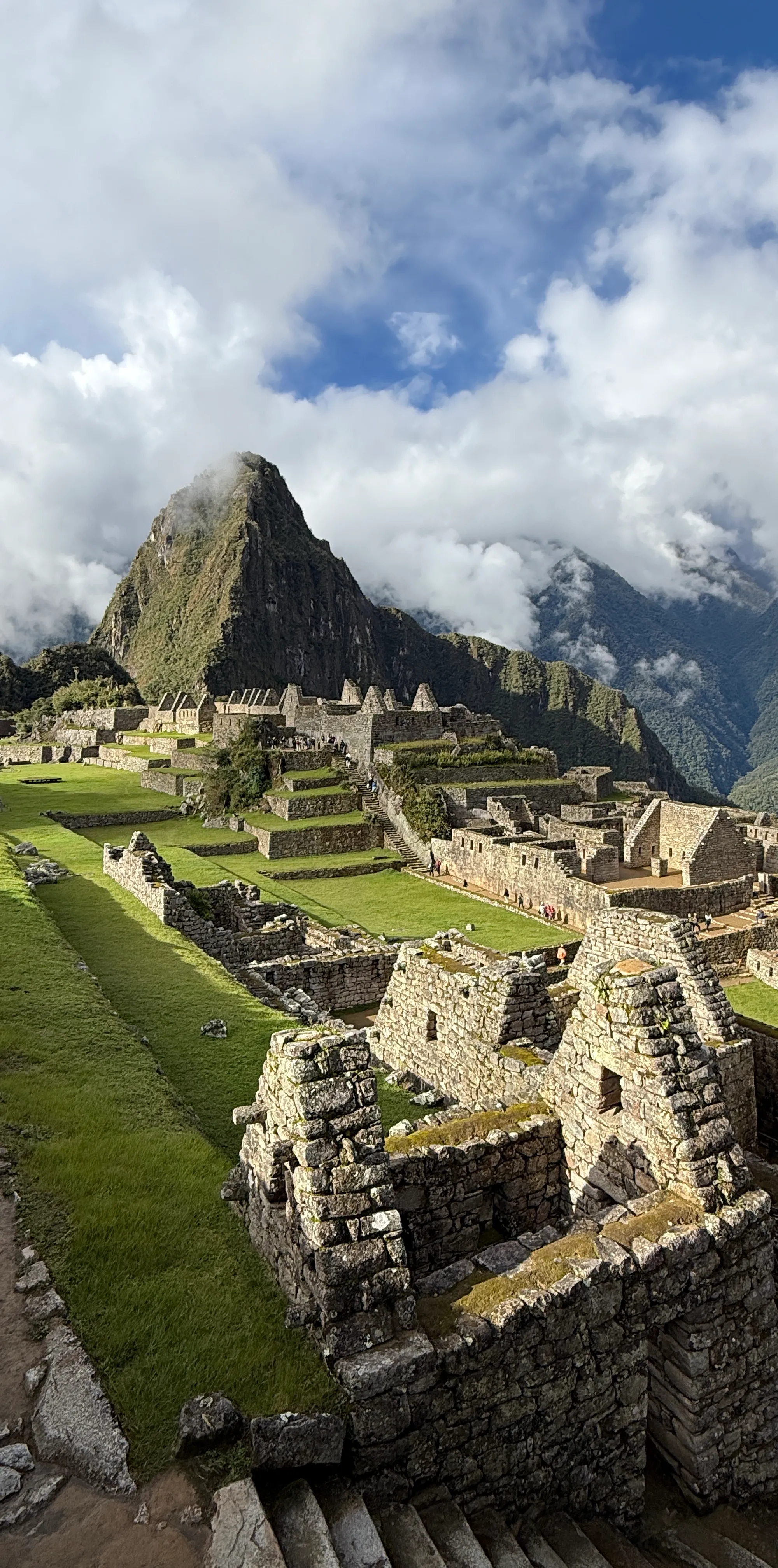
It was pouring with rain, and the whole mountain seemed to have disappeared into a fog bank. Then, incredibly quickly, the weather started moving through the mountains.
Rain. Cloud. Fog. Sunshine.
And suddenly there it was.
The weather in those mountains is mercurial, so give it time.
It is hard to comprehend that the Incas built this extraordinary city so high in the mountains, tucked away in such an impossible landscape. The engineering, architecture, and sophistication of the civilization are fascinating.
But for me, it wasn't only about the history.
There is something about Machu Picchu itself that feels almost spiritual.
If you can find a quiet little nook away from everyone else, stop. Don't take a photograph. Don't listen to your guide for a minute.
Just stand there and take it in.
MY MACHU PICCHU TIPS
1. BUY YOUR MACHU PICCHU TICKETS WELL IN ADVANCE. (We had our airBnb host book everything which made it WAY easier- see notes in Sacred Valley)
This is probably my biggest practical tip. Entrance tickets are date and circuit specific, and availability is limited. Buy them through the official Peruvian Ministry of Culture platform.
Official Machu Picchu tickets: Buy Machu Picchu entrance tickets
2. BOOK YOUR TRAIN EARLY TOO.
There are different levels of train service. The regular trains are perfectly comfortable, while the Vistadome has panoramic windows and the Vistadome Observatory gives you an even more immersive experience, with 360-degree views. Depending on the service, there can also be music and entertainment.
3. REMEMBER THERE ARE SEPARATE TICKETS.
You need to think of this as several different parts:
Train → Aguas Calientes → bus up the mountain → Machu Picchu entrance.
The bus from Aguas Calientes to Machu Picchu is a separate booking. Don't assume your train or entrance ticket includes it.
4. GET A REALLY GOOD GUIDE.
Book one in advance if you can. Don't just grab whoever happens to be available when you arrive. Ours was worth every penny, particularly after our ticket problem.
And yes, they are also your photographer.
5. DOWNLOAD EVERYTHING.
Save your Machu Picchu tickets and other confirmations to your phone before you leave. We hadn't properly downloaded ours and our guide ended up helping us get through the problem.
6. CONSIDER OLLANTAYTAMBO AS YOUR BASE.
If you're already staying in the Sacred Valley, you don't necessarily need to move to Aguas Calientes. We stayed in Ollantaytambo and used it as our base for the round trip, which worked beautifully for us. The train is only about 1½ hours each way.
7. OR STAY IN AGUAS CALIENTES.
If you want a slower experience, there are lots of hotels in Machu Picchu Pueblo. Staying there means you can get up early and be closer to the mountain.
8. OR GO FULL LUXURY.
The Hiram Bingham, A Belmond Train is the splurge option, travelling from Cusco or Ollantaytambo to Machu Picchu. And Sanctuary Lodge is the Belmond hotel right beside the entrance.
9. DON'T PANIC ABOUT THE WEATHER.
This one is important.
If you arrive and it's pouring with rain and you're looking at nothing but a wall of fog, don't despair. The weather moves incredibly quickly through those mountains.
We watched it go from rain and complete cloud cover to sunshine.
- BRING SUNSCREEN, A HAT AND A RAIN PONCHO.
I completely underestimated the sun on the train. The trains have huge windows, and some have overhead glass as well. I absolutely roasted and wished I'd brought a hat. Bring sunscreen and a hat, even if the day doesn't look particularly sunny.
And pack a small fold-up rain poncho. The weather in the mountains can change incredibly quickly, particularly if you're travelling outside the dry season. We went from pouring rain and fog to sunshine, so having something lightweight that you can throw over yourself is a very good idea.
- GIVE YOURSELF TIME TO ADJUST TO THE ALTITUDE.
One thing worth knowing is that Machu Picchu is actually considerably lower than Cusco. Cusco sits at around 3,400 metres, while Machu Picchu is around 2,430 metres.
But if you're flying into Cusco from sea level, don't make Machu Picchu your first thing. Give yourself a couple of days to acclimatize if you have the time. We spent time in the Sacred Valley first, which I think was a much gentler way to start the trip.
Altitude sickness can affect people differently, and even Machu Picchu is high enough that it's worth taking seriously. The CDC recommends allowing time to acclimatize when travelling to high elevations.
- DON'T GO CRAZY WORRYING ABOUT WHICH ROUTE TO CHOOSE.
I spent far too much time stressing about this.
There are now three main circuits and multiple routes, and once you start reading about them online it can feel as though choosing the wrong one will ruin your entire Machu Picchu experience.
It won't.
For a first visit, Circuit 2 is generally considered the best all-round choice because it combines the famous Machu Picchu panorama with a walk through the main archaeological area of the citadel. It is also the route most commonly recommended for first-time visitors.
Within Circuit 2 there are 2-A and 2-B.
We did 2-B, the Lower Terrace Route, and we loved it. It gave us the classic views and allowed us to experience the citadel itself. Recent guides tend to describe 2-A as the slightly more comprehensive option, while 2-B is a little more straightforward.
If it's your first time and you want the classic Machu Picchu experience, I'd look at Circuit 2 first.
If you're particularly interested in the panoramic photographs, Circuit 1 has the higher terraces and spectacular elevated views, but you don't get the same experience of walking through as much of the archaeological heart of the citadel.
And if you're interested in climbing Huayna Picchu or Huchuy Picchu, that's a different set of routes within Circuit 3. Those are more about adding a mountain experience to your visit. Chris did Circuit 3 and loved it and his experience and pictures were every bit as wonderful as ours.
A LITTLE MACHU PICCHU HISTORY
Machu Picchu was built in the 15th century, during the height of the Inca Empire, at around 2,430 metres above sea level. It sits on a dramatic ridge between the Andes and the Amazon basin, surrounded by mountains and cloud forest.
The exact purpose of Machu Picchu isn't completely understood, which is part of what makes it so fascinating. It appears to have served a combination of religious, ceremonial, astronomical, agricultural and residential purposes, with temples, plazas, homes, agricultural terraces and an ingenious system of water channels.
The Incas were extraordinary engineers. The way they built into the mountain, created enormous terraces and fitted huge stones together with remarkable precision is astonishing, particularly when you consider the location and the technology available to them.
Machu Picchu was abandoned in the 16th century, around the time of the Spanish conquest of the Inca Empire. Unlike Cusco, it wasn't destroyed by the Spanish, and its remote location helped preserve it.
It remained largely unknown to the outside world until 1911, when American explorer Hiram Bingham visited the site and brought it to international attention.
There are still mysteries about Machu Picchu that we don't have answers to.
Maybe that's part of the magic.
You are standing in a place built more than 500 years ago by a civilization whose understanding of architecture, agriculture, astronomy and engineering was extraordinarily sophisticated, in a landscape that still feels almost impossibly hidden.
And then the clouds roll in, the mountains disappear, and for a moment it feels like you've been let into a secret.
Nothing published from Machu Picchu: what I wish I'd known before we went yet.