Humberto Valderrama
There is a strong sense of place in his murals, a celebration of the landscapes, wildlife, traditions and cultural identity of western Mexico.
The Return of the Eternal Souls
Humberto Valderrama and the art of remembering in San Pancho, Mexico
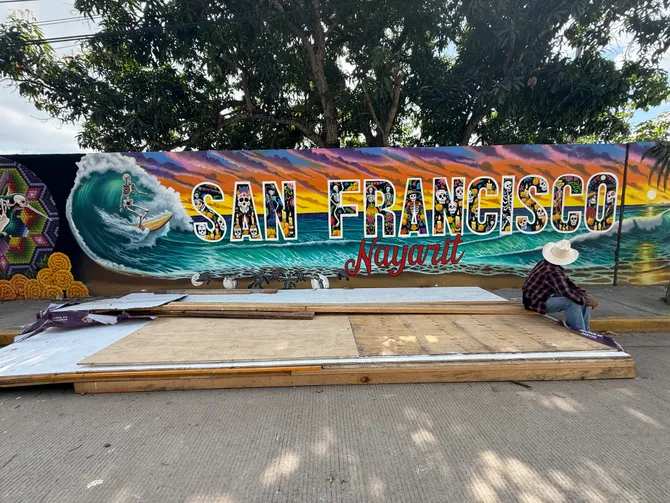
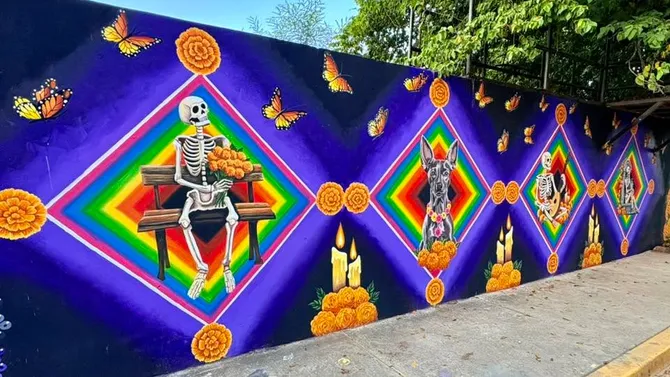
On a dusty street in a small surf town in Nayarit, a neglected wall across the street from the town cemetery held the promise of something extraordinary. We watched it happen, cruising by in our golf cart over the course of a month, as Mexican muralist Humberto Valderrama and his two assistants transformed an entire stretch of wall into a celebration of life, death and cultural identity.
There was nothing particularly remarkable about the wall in San Pancho, a little inland from the main village. Cracked, weathered and bordering a dusty street, it was the sort of uninspiring piece of town infrastructure you barely register as you pass. A dead zone, really. No pun intended.
Then Humberto Valderrama and his assistants arrived.
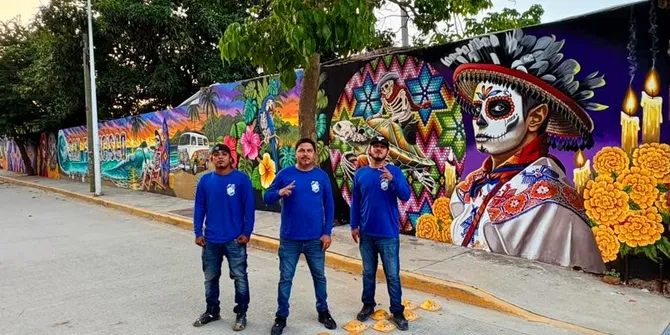
Each time we passed, something had changed. Slowly but steadily, the mural took shape. The work was incredibly detailed, with sections tackled one at a time, then covered with drop cloths while the team moved on to the next.
It was an enormous undertaking. The weather was stinking hot, the sort of heat that makes you search for shade and question why anyone would voluntarily be outside for very long. Yet there they were, day after day, working on that endlessly long wall.
I honestly don't know how they did it.
We would stop to watch, and as the weeks went by, the painters became familiar faces. We would wave to each other as we drove by. Occasionally, towards the end of a long day, we would bring them a few beers. A small gesture, but one that became part of our own little San Pancho routine.
A tradition written on walls
In Mexico, murals have always been about more than making a wall look beautiful. They are part of a long tradition of using public art to tell stories, preserve history, challenge authority and assert cultural identity. Unlike paintings hanging in galleries or private collections, murals belong to the streets and to the people.
The roots of Mexico's celebrated mural movement can be traced to the years following the Mexican Revolution (1910–1920), when the country was redefining itself and confronting questions of national identity, inequality and its Indigenous heritage.
In the 1920s, artists including Diego Rivera, José Clemente Orozco and David Alfaro Siqueiros began creating monumental works on the walls of public buildings. Supported in part by the government, the movement had an ambitious educational and political purpose: to make art accessible to ordinary people and tell the story of Mexico through images rather than words alone.
Their subjects were far from decorative. They depicted ancient civilizations, the Spanish conquest, colonial oppression, revolution, workers, peasants and the struggle for social justice. These were stories about power, class, history and belonging, painted on walls for an entire population to see.
Murals became a way of reclaiming history, giving visibility to people and cultures that had been marginalized, and challenging whose stories were being told. They could be acts of protest, education and national pride, sometimes all at once.
That tradition has continued to evolve. Today, across Mexico, muralists use public spaces to celebrate regional heritage, preserve Indigenous traditions, address contemporary social issues and give communities a visible expression of their identity.
A mural doesn't have to be political to make a statement. Sometimes the act of putting a community's history, culture and values on a public wall is powerful enough in itself.
In San Pancho, Humberto Valderrama was doing just that.
The artist behind the wall
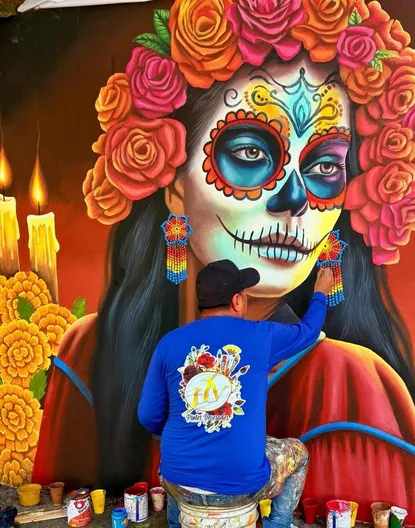
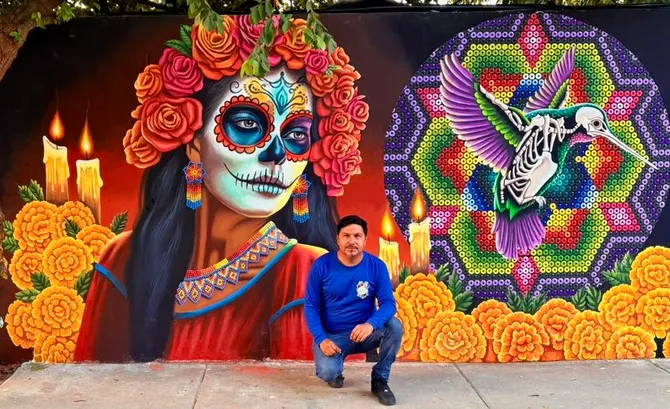
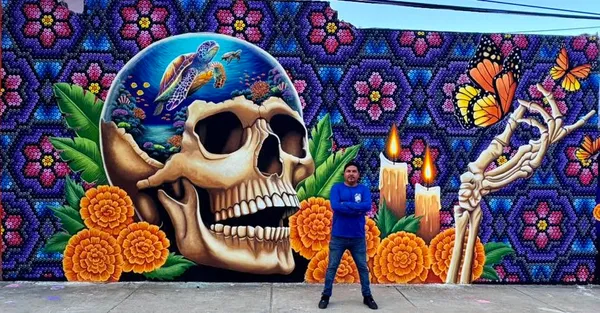
Humberto Valderrama is a Mexican painter and muralist from Coamiles, a small community in the municipality of Tuxpan, in the state of Nayarit. His work is deeply connected to the region, drawing on its natural environment, cultural heritage and the rich visual traditions of Wixárika (Huichol) art.
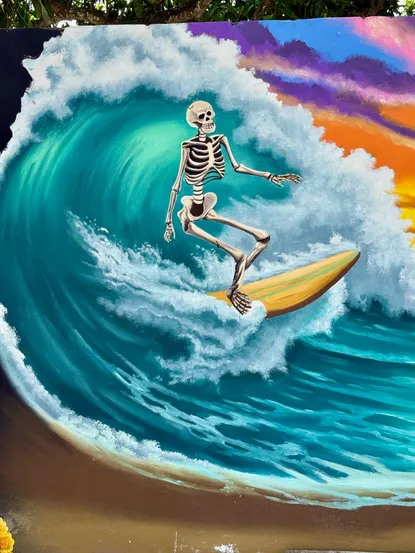
Animals and memory are recurring themes in his work. Color is central, too. Bold patterns, intricate detail and symbolic imagery come together in compositions that are often monumental in scale. There is a strong sense of place in his murals, a celebration of the landscapes, wildlife, traditions and cultural identity of western Mexico.
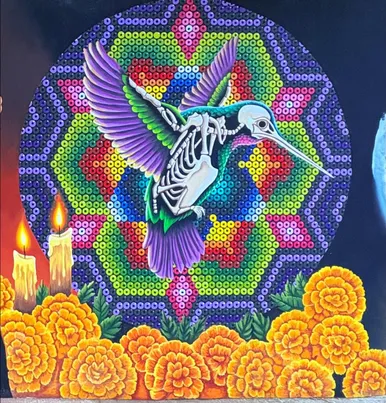
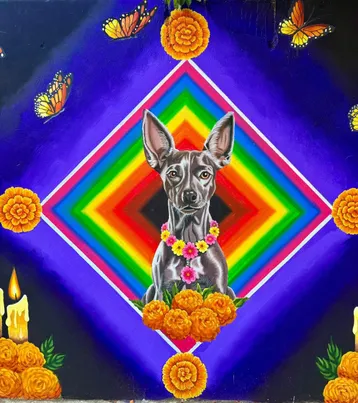
He has developed an impressive portfolio of public commissions across Nayarit. Among his most ambitious projects is La Grandeza Jaguarundi, a collection of 25 murals at the Universidad Tecnológica de Bahía de Banderas. Completed with a team over approximately three months, the project brought together imagery inspired by the Wixárika worldview, regional wildlife and the cultural heritage of the area.
A town shaped by its natural world
San Pancho, officially San Francisco, is a small coastal community with a surprisingly strong environmental conscience. It is particularly well known for its sea turtle conservation work, which has been part of the town's identity for more than three decades.
In fact, it was partly how we came to be here. Frank D. Smith, one of the founders of San Pancho's turtle conservation movement, had been an old neighbor of Noah's in Idyllwild, California, where he grew up. We'd heard about this little Mexican town through Frank, and that personal connection eventually persuaded us to come and spend a couple of months in this corner of Nayarit.
Since 1992, local conservationists and volunteers have worked to protect the sea turtles that return to nest along this stretch of Pacific coastline. What began as a community initiative has grown into an established conservation program involving beach patrols, nest protection, incubation and the release of hatchlings back into the ocean. The turtles have become part of San Pancho's identity, a reminder of the close relationship between this small town and the natural world surrounding it.
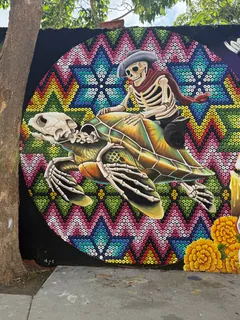
It is fitting, then, that the natural world also finds its way into Humberto's work. Animals and their place in the collective memory of a region are recurring themes in his murals. The sea turtles, so closely associated with San Pancho, provide another connection between the artwork and the place it inhabits.
There is something lovely about that. A mural celebrating the return of eternal souls, painted in a town whose conservation efforts have helped more than a million Olive Ridley hatchlings make their way into the Pacific. A different kind of return, perhaps, but one that speaks to the same enduring relationship between a place, its natural world and the generations that follow.
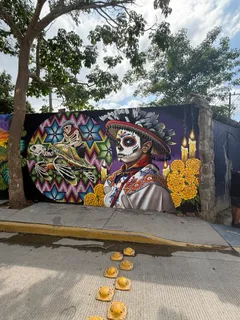
The return of the eternal souls
El Retorno de las Almas Eternas was created for San Pancho's 2025 Día de los Muertos celebrations, but this was no modest cemetery decoration. The year before, Humberto had painted the smaller entrance gate at the cemetery in neighboring Sayulita. This time, he took the idea and put it on steroids.
The scale was extraordinary. As was the detail. What started as a long, cracked wall opposite the cemetery had become a monumental work of public art, extending around the walls and steps leading to the main entrance.
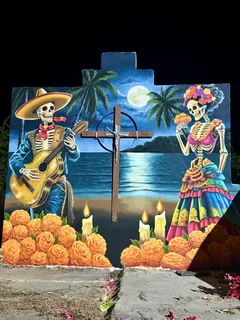
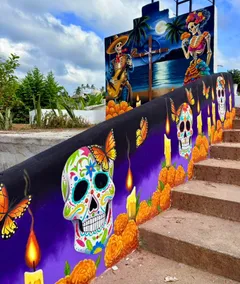
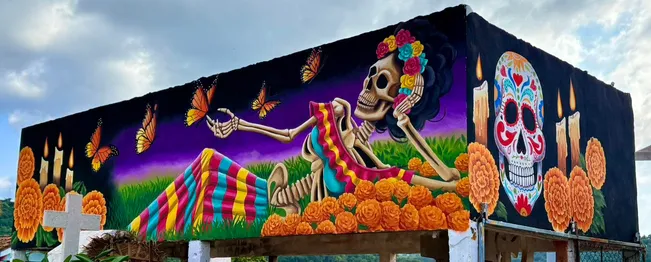
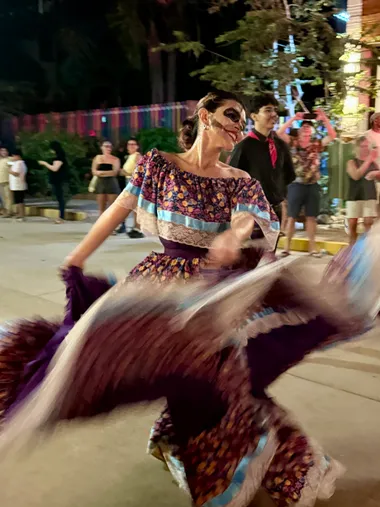
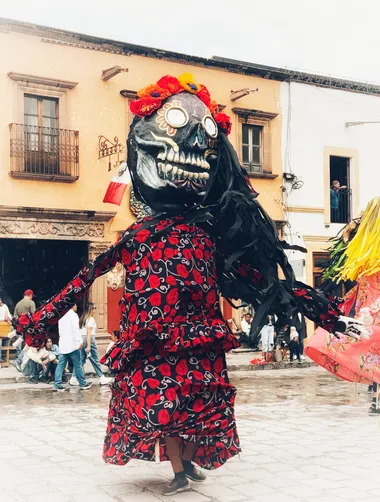
Día de los Muertos is one of Mexico's most distinctive and enduring traditions. It is less about mourning than remembering, a time when families welcome the spirits of those who have died through offerings of flowers, candles, photographs, and favorite foods. The brilliant orange marigold, or cempasúchil, is particularly important; its color and fragrance are traditionally believed to guide the souls home.
But there was something else happening in San Pancho that year.
San Pancho has always had an artistic streak. Unlike many small coastal towns, it has a creative energy that is hard to miss. Murals appear on walls throughout the village, alongside galleries, studios and independent creative spaces. Art is already part of its character.
Yet San Pancho has often lived in the shadow of its better-known, larger and more touristy neighbor, Sayulita. A little dustier, quieter and less polished, it has a personality all its own. In 2025, however, it stepped into the spotlight. For the first time in years, San Pancho was chosen to host the main Día de los Muertos parade celebrations rather than Sayulita.
Humberto's monumental mural became part of that moment. Its unveiling brought local officials, residents and visitors together, and there was a palpable sense of pride in what had been created. It was a significant new addition to a town that already values its art, but this was something on an entirely different scale.
I'm always fascinated by the ability of art to transform physical spaces, but perhaps even more by what happens to the people who live in those spaces, or simply pass through them. A neglected wall becomes a landmark. An overlooked corner becomes something people stop to admire. Something that was once barely noticed becomes a source of collective pride.
That, to me, is the real power of public art.
Humberto Valderrama Diaz Facebook