The Man Behind the Hand: Remembering Pedro Friedeberg
His hand-shaped chair, with its open palm for a seat and long fingers rising to form the back, is instantly recognisable.
Some artists leave behind a body of work. Pedro Friedeberg left behind an entire way of seeing the world.
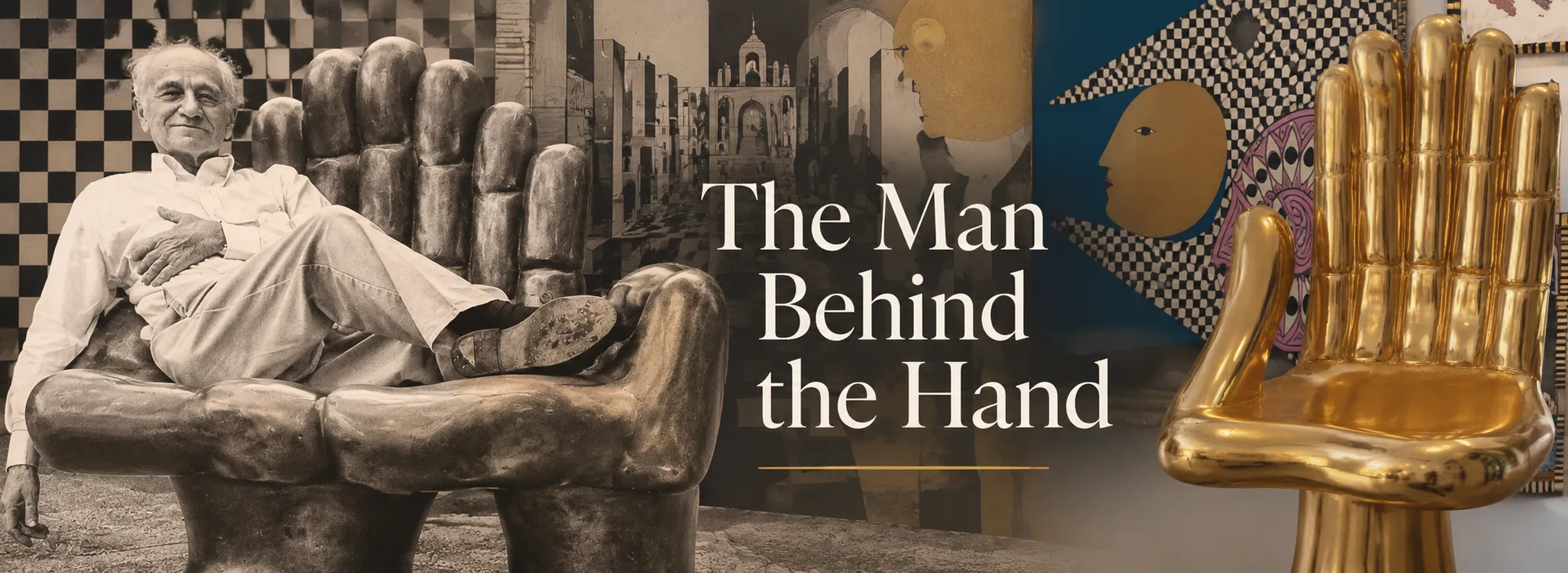
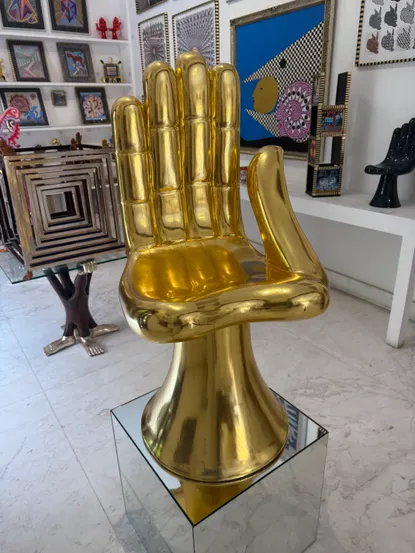
His hand-shaped chair, with its open palm for a seat and long fingers rising to form the back, is instantly recognisable. It is witty, unexpected and just strange enough to make you look twice. Over time, it became the work most closely associated with him, reproduced and collected around the world.
But the chair was only one expression of a much larger imagination. To understand Pedro Friedeberg, you have to look beyond the hand, beyond the familiar photographs of his work, and into the elaborate universe he spent a lifetime creating.
A life that began elsewhere
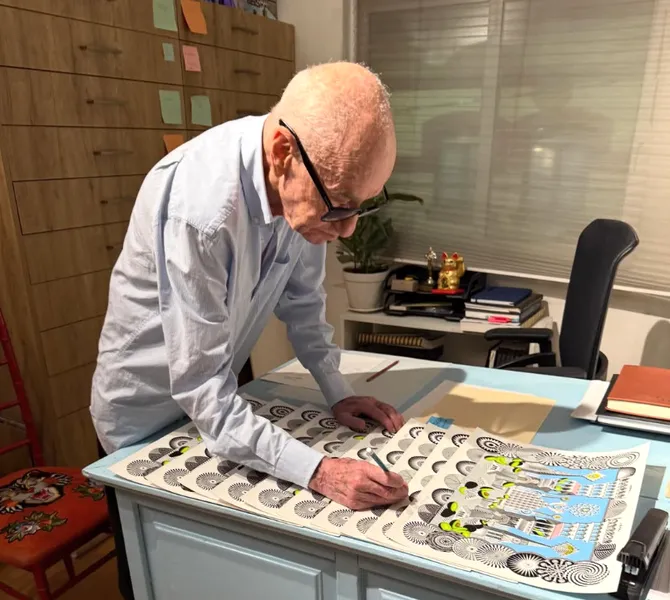
Pedro Friedeberg was born in Florence, Italy, in 1936, into a Jewish-German family. His parents brought him to Mexico when he was a young child, escaping the gathering dangers of the Second World War. Mexico became his home, and eventually the place where he developed one of the most distinctive artistic voices in the country’s postwar cultural life.
He initially studied architecture at the Universidad Iberoamericana in Mexico City. It was a natural starting point for someone so interested in perspective, structure and the possibilities of space. But conventional architecture was never going to contain him for long.
He moved towards art, encouraged by the architect and artist Mathias Goeritz, whose influence helped bring him into contact with Mexico’s adventurous postwar art scene. Through that world, Friedeberg also became connected with artists such as Remedios Varo, who supported his early career.
His first solo exhibition took place in 1959 at Galería Diana in Mexico City. He was still in his early twenties, already developing the visual language that would distinguish him from the prevailing artistic movements of his time.
Mexico was an especially fertile place for such a sensibility. Surrealism had found a particular home there, and artists were exploring the boundaries between reality and imagination. Yet Friedeberg never sat comfortably inside a single category. He was an artist, designer, sculptor and architectural thinker, interested in historical styles, elaborate ornament, geometry, symbolism and the absurd.
He borrowed freely, combined unexpectedly and followed his own instincts.
The result was work that could be beautiful, intricate, humorous and faintly unsettling, sometimes all at once.
An architect of impossible worlds
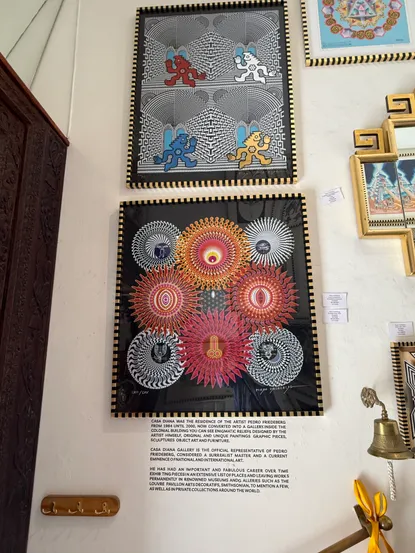
His drawings often contain elaborate perspectives, repeating geometric forms, architectural fantasies and intricate patterns that seem to extend indefinitely. There is a sense of order, but it is an order belonging to a private universe rather than the familiar one.
Where modernist design often sought simplicity and the removal of ornament, Friedeberg embraced its opposite. He filled spaces with detail. He played with historical references, decorative excess and the possibilities of the eye being deceived.
He was not interested in making art that quietly disappeared into a room. His work demanded attention, sometimes with a wink.
In 1961, he joined Los Hartos, an experimental group associated with Goeritz that challenged the conventions and pretensions of the art establishment. Friedeberg's own approach was irreverent. He was suspicious of fashion and wary of the idea that art had to follow a prescribed direction to be taken seriously.
That independence stayed with him throughout his career.
His furniture, paintings, sculptures and architectural interiors are difficult to separate from one another. A chair can become a sculpture; a wall can become a dense composition; an interior can become a three-dimensional drawing. His work repeatedly asks us to reconsider the objects and spaces we think we already understand.
The famous Hand Chair, conceived in the early 1960s, captures this perfectly. It is furniture, certainly, but it is also a playful challenge to the idea that furniture must be ordinary, discreet or even entirely sensible.
Its international popularity eventually came to overshadow much of his wider output. Friedeberg himself expressed ambivalence about the chair's commercial success. It was the work that brought him recognition, but he had spent decades making far more than one iconic object.
A world of his own
I began to appreciate the scale of that world during a visit to Casa Diana in San Miguel de Allende with my friend Mimi. Read about Casa Diana here.
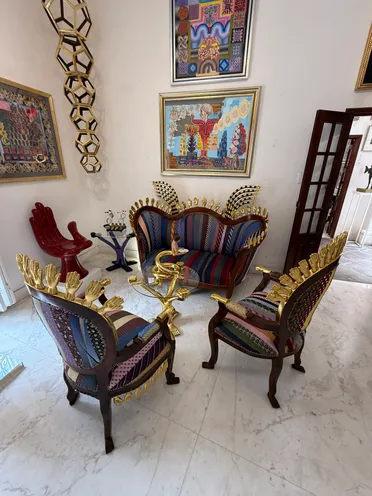
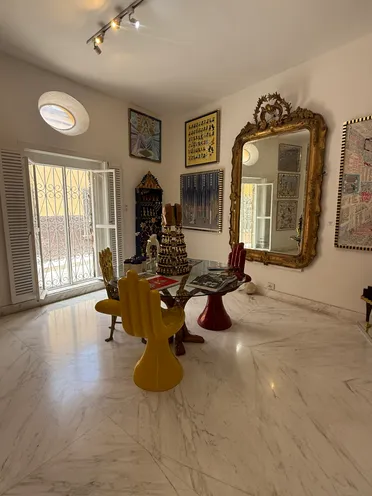
At Casa Diana, I began to understand that Friedeberg's eccentricity was not a decorative persona attached to his work. It was embedded in the work itself, in his appetite for detail, his fascination with architecture and his willingness to take an idea seriously even when it appeared absurd.
The pleasure of not fitting in
Behind his fantastical images was a serious and sustained investigation of geometry, perspective, ornament and space. His drawings required patience and extraordinary attention. The apparent playfulness of the finished work rested on years of looking, studying and making.
His achievement was not simply that he created unusual things. It was that he developed a recognisable visual language and remained committed to it over more than six decades, without allowing changing fashions to dictate its direction.
That persistence matters. The art world, like every other world, has its preferred movements, its fashionable ideas and its rules about what is current. Friedeberg worked at an angle to those expectations. His art could be elaborate when simplicity was in favour, decorative when ornament was dismissed, and humorous when seriousness was the expected pose.
His work also carries a particular generosity. It invites us to look closely, to notice the improbable detail, to enjoy the collision of things that should not quite belong together. It does not require us to solve every symbol or understand every reference before we can enjoy it.
Sometimes the pleasure is simply in the looking.
A life in San Miguel
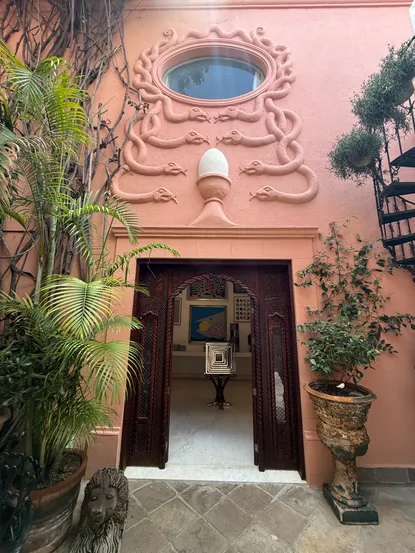
By the time Pedro Friedeberg made his home in San Miguel de Allende, he had already established an international reputation. His work had been exhibited widely, and his career had crossed the boundaries between fine art, design and architecture. In 2012, he received the Bellas Artes Medal, one of Mexico's major recognitions for artistic achievement.
Yet there is something fitting about the fact that his world can still be encountered through a house and gallery rather than only through a museum retrospective.
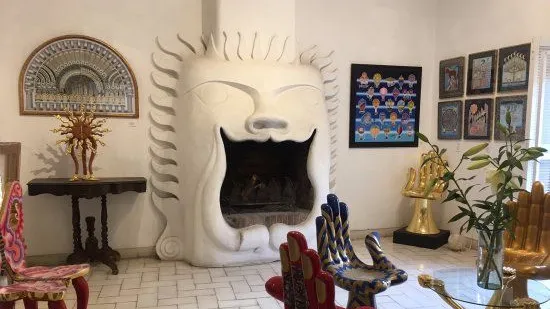
Casa Diana gives visitors a more intimate point of entry. You can look at the work and also see how thoroughly its visual language inhabited the space around it. The rooms, furnishings and decorative details reveal an artist who did not confine his imagination to a canvas or pedestal.
During our visit, I was struck by the way creativity seemed to continue through the people around the house, too. His longtime companion, Carmen Gutiérrez, is an artist in her own right, and the gallery has remained a place where his work can be encountered. There was a sense of art as something lived with, passed between people and kept active through daily attention.
Remembering Pedro
Pedro Friedeberg died in San Miguel de Allende on 5 March 2026, aged 90, surrounded by his family.
His legacy will always include the Hand Chair, the piece that made his name recognisable far beyond the art world. But it should also include the countless drawings, paintings, objects and environments through which he pursued his own peculiar vision.
New York Times obituary: https://www.nytimes.com/2026/04/03/arts/design/pedro-friedeberg-dead.html
IG: https://www.instagram.com/pedrofriedeberg
Where to Find Pedro Friedeberg’s Work
San Miguel de Allende
Casa Diana, Recreo 48
Casa Diana, Pedro’s former home and the setting for my visit with Mimi, offers an intimate introduction to his imagination. The elaborate interiors, sculptural fireplaces, intricate patterns and miniature drawings in his art journal reveal an artist whose creativity extended well beyond individual paintings or objects.
IG: https://www.instagram.com/galeria.casa.diana/
Centro Cultural Ignacio Ramírez El Nigromante, Hernández Macías 75
The exhibition Pedro Friedeberg. Hilaridad y Melancolía opened on 10 October 2026 and is scheduled to run until 28 February 2027. It brings together more than 500 works across three San Miguel venues, offering an opportunity to explore different aspects of his career, including paintings, prints, personal material and a recreation of his studio.
Casa del Mayorazgo de la Canal, Canal 4
Another venue in the exhibition, this historic building presents Líneas de fuga, focusing on Friedeberg’s use of geometry, perspective and sculpture.
Beyond San Miguel de Allende
Museo de Arte Moderno, Mexico City
Mexico City’s Museo de Arte Moderno is a useful institution to check for Friedeberg’s work and related exhibitions. Contact the museum before visiting to confirm what is currently on display.
Museo Franz Mayer, Mexico City
The museum presented La Casa Irracional, an exhibition exploring Friedeberg’s imaginative approach to interiors and design in 2016. It is another worthwhile place to check for future exhibitions or related programming.
Museo de Arte Contemporáneo de Querétaro
Friedeberg’s work was featured in the exhibition Ciudad Épsilon in 2025. Check with the museum for current displays and future opportunities to see his work.
Explore Further
The artist’s official website provides a starting point for exploring his work and exhibition history:
- Exhibitions: https://pedrofriedeberg.com/exhibiciones/
- Sculpture: https://www.pedrofriedeberg.org/escultura
The 2022 Netflix documentary Pedro, directed by Liora Spilk Bialostozky, offers an intimate portrait of Pedro Friedeberg, capturing his humour, eccentricity and daily life, and revealing the man behind the extraordinary art. For anyone curious about the mind behind the famous Hand Chair, it’s a chance to hear Pedro in his own words and discover more about the artist beyond his work.