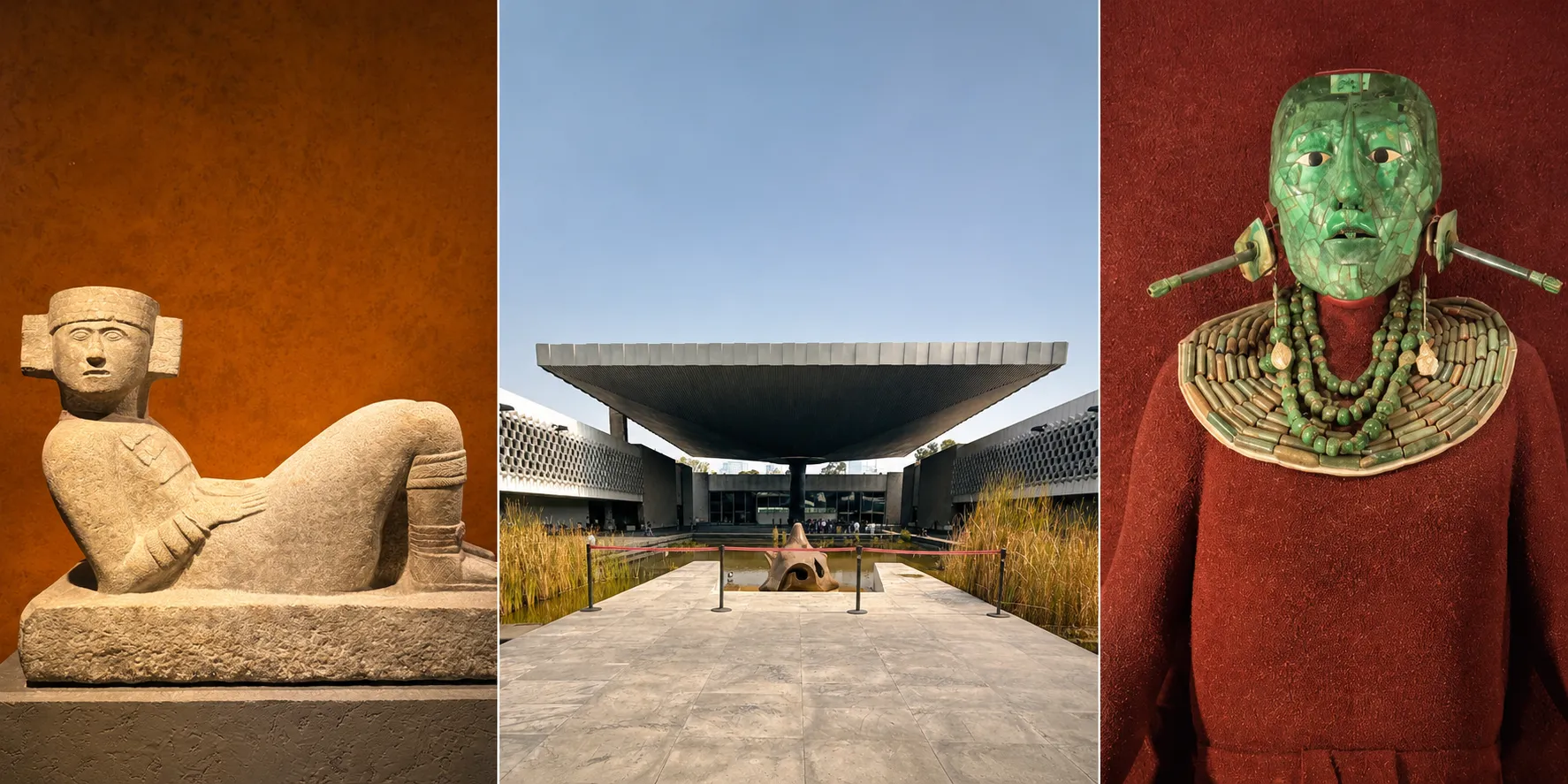
The Museum of Anthropology: Mexico City's Unmissable Museum
If I could recommend just one museum to visit in Mexico City, it would be the National Museum of Anthropology
If I could recommend just one museum to visit in Mexico City, it would be the National Museum of Anthropology (Museo Nacional de Antropología). Closely followed, I should add, by Frida Kahlo's Blue House in Coyoacán. They are very different experiences, but both are essential and extraordinary.
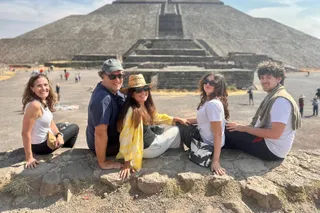
This is a world-class museum, not only for the extraordinary collection it houses but for the building itself and the remarkable story it tells of Mexico. This is a museum I could go back to again and again. For a first visit to Mexico City, this museum paired with the Pyramids of Teotihuacán would be at the top of my list. You can read my dispatch on visiting Teotihuacán here.
What I hadn't quite appreciated before visiting was just how many different civilisations shaped this part of the world. We hear so much about the Aztecs and the Maya that it's easy to assume they were the whole story. They weren't. There were Olmecs, Zapotecs, Mixtecs, Toltecs, Teotihuacanos, and many others, each with their own cultures, artistic traditions, beliefs, and ways of understanding the world. Some flourished centuries apart; others overlapped and influenced one another.
The museum brings these worlds together under one roof, and it is quite a story.
The building: an architectural landmark
Even before you reach the collections, the building makes an impression. Designed by Mexican architect Pedro Ramírez Vázquez, the museum opened in 1964 and was an ambitious national project intended to celebrate and preserve Mexico's Indigenous heritage.
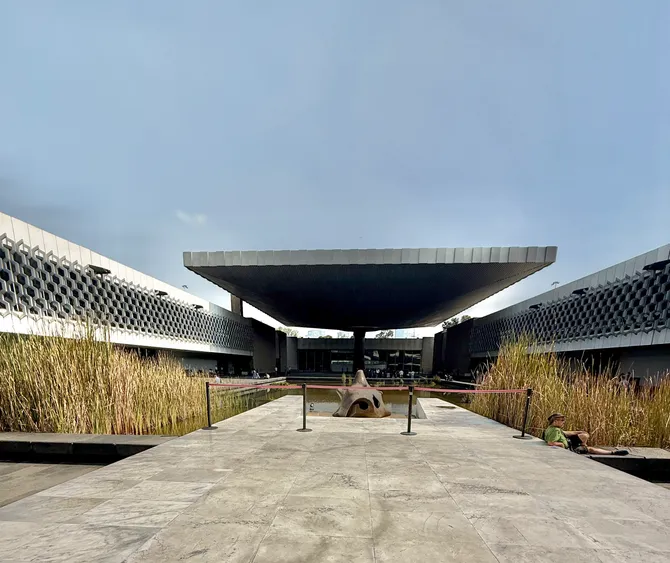
The architecture is modernist, monumental and beautifully considered. Galleries are arranged around a vast central courtyard, with a reflecting pool and gardens providing a welcome pause between the collections.
The centrepiece is El Paraguas, or The Umbrella, an enormous concrete canopy supported by a single column. Water cascades down one side, creating a rather spectacular focal point. It's both a feat of engineering and a clever architectural device, providing shade and shelter while leaving the courtyard open to the sky.
I particularly liked the way the building allows you to move between enclosed galleries and open spaces. It feels almost like a modern interpretation of the great ceremonial courtyards of ancient Mesoamerica. There is a wonderful sense of scale without the building feeling disconnected from its surroundings.
How to navigate the museum
One thing I wish I'd known before arriving is that the layout isn't immediately obvious. The galleries are arranged around the central courtyard, rather than along one straightforward route, and it's easy to find yourself wandering without quite knowing where to go next.
There are two floors. The ground floor is devoted to archaeology and the ancient civilisations of Mexico, while the upper floor explores the Indigenous cultures of the country today. We mainly focused on the ground floor as there is a lot to take in on a first visit.
We headed straight through the central courtyard towards the heart of the museum, where the enormous Piedra del Sol (Sun Stone) is displayed in the Mexica Hall. Often referred to as the Aztec calendar stone, this monumental carved stone is one of the museum's most recognisable treasures. It's quite something to stand in front of it and take in the extraordinary detail. If you are short on time, this is the one object I'd make a point of finding.
If I were doing it again, with around three hours to spare, I'd take a little more time to follow the museum's chronological progression. Rather than heading straight for the Sun Stone as we did, I'd start on the right-hand side of the ground floor, exploring the early settlement of the Americas and the Preclassic cultures before moving through the galleries devoted to Teotihuacan and the Toltecs. I'd then make my way to the Mexica collection and the famous Sun Stone, before allowing time for the fascinating collections from Oaxaca, the Gulf Coast, the Maya world, and western Mexico.
It's a lot to take in, so don't feel you need to read every label or see absolutely everything. Part of the pleasure is simply taking in the extraordinary objects and letting the story unfold.
More Than Meets the Eye: The Story Behind A Few Museum Treasures
I've chosen a handful of pieces that caught my attention and explored their stories a little further, perhaps to read before or after your visit.
The Sun Stone: The Star of the Museum
We were drawn to this piece like moths to a light. It was the first room we accidentally wandered into, and we headed straight towards it, not knowing quite what we were looking at or the extraordinary history behind it.
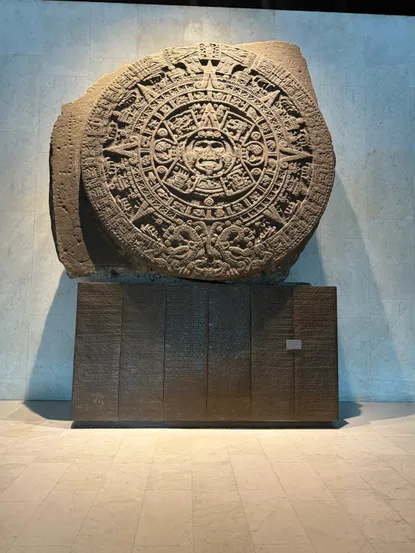
The enormous Piedra del Sol, or Sun Stone, is probably the museum's most famous treasure. Measuring around 3.6 metres across and weighing some 24 tonnes, this carved basalt disc is quite something to stand in front of. Often referred to as the Aztec Calendar, it's not actually a sundial or calendar in the conventional sense, but a remarkable representation of how the Mexica understood time, the universe, and the creation of the world.
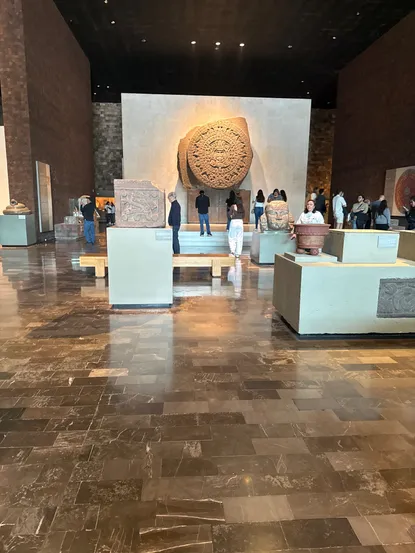
Often referred to as the Aztec Calendar, it's not actually a sundial or a calendar in the conventional sense. It's a representation of how the Mexica understood time and the universe. At its centre is a face generally identified as Tonatiuh, the sun deity, surrounded by intricate rings of symbols representing the days, the heavens, and the different ages of the world. The Mexica believed they were living in the Fifth Sun, an age that, like those before it, would eventually come to an end.
The stone was discovered in 1790 during excavations in Mexico City's main square, the Zócalo, where it had been buried for centuries following the Spanish conquest. It was subsequently displayed beside the Metropolitan Cathedral before eventually finding its home here in the National Museum of Anthropology.
The Stone of Tizoc: War, Victory and Sacrifice
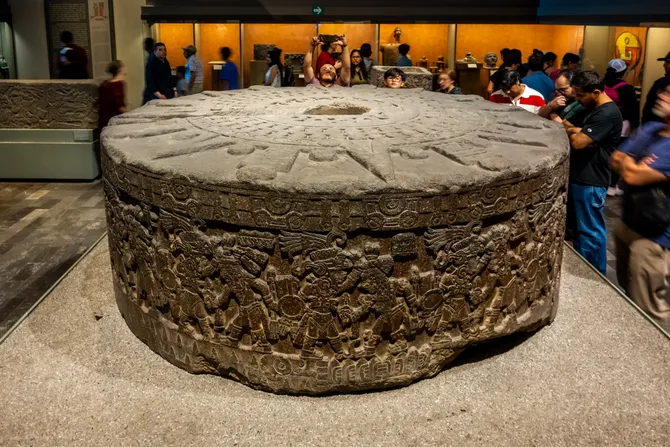
Just a little further along in the same Sala Mexica as the Piedra del Sol, you'll come across another enormous circular stone. This is the Stone of Tizoc, named after the Mexica ruler who reigned from 1481 to 1486.
Look closely at the sides and you'll see fifteen carved scenes showing a victorious warrior grasping defeated enemies by the hair. These are generally interpreted as representations of military victories, a way of recording the power and expansion of the Mexica empire.
But the stone may have had a much darker purpose, too. Its hollow centre and carved channel suggest it was used as a ritual vessel to receive offerings, including the hearts of sacrificial victims. Its precise ceremonial function is still debated.
Discovered in Mexico City's main square in 1791, the stone was initially taken to the university, then buried again before being moved back into public view in 1824. Today it sits alongside the Piedra del Sol, another reminder of just how much history is contained in this one room.
For more information, check out:
La historia póstuma de la Piedra de Tízoc – Arqueología Mexicana
https://arqueologiamexicana.mx/mexico-antiguo/la-historia-postuma-de-la-piedra-de-tizoc?
It explains the fifteen carved scenes, the defeated rulers, and the stone's possible role in the Mexica gladiatorial sacrifice ceremony.
For a shorter, official museum explanation, see:
Piedra de Tízoc: el lenguaje del relieve – INAH
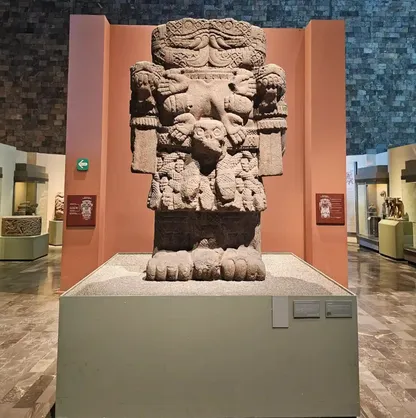
Coatlicue: the goddess they buried twice
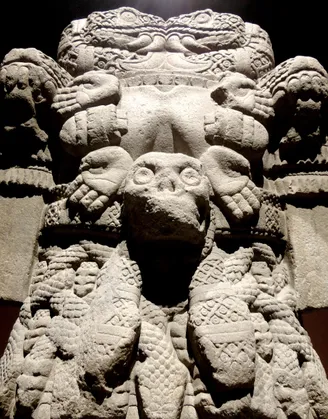
One of the most extraordinary stories belongs to Coatlicue, the enormous Mexica goddess whose name translates roughly as 'She of the Serpent Skirt'. Discovered in Mexico City's main square in 1790, the colossal sculpture was initially taken to the Royal and Pontifical University, where it was put on display. But it didn't stay there for long. The Spanish colonial authorities became concerned that Indigenous people were visiting the statue, kneeling before it and leaving offerings, so they ordered it buried again. Even after it was unearthed for visiting scholars, it was eventually hidden once more. It wasn't until much later that it became publicly accessible. There's something quite extraordinary about that story: a sculpture that survived for centuries beneath the city, only to be buried again because the beliefs it represented had never entirely disappeared.
Treasures That Almost Left Mexico
Quite a few pieces in the museum have had extraordinary journeys, including being looted, smuggled out of Mexico and almost sold to overseas museums and private collectors.
The enormous Placeres Relief (27.5 × 8.1 feet), a carved Maya temple façade now displayed here, is a particularly remarkable example. It was cut into 48 pieces and shipped to New York in the 1960s, where it was offered to the Metropolitan Museum of Art for $400,000. The Met refused to buy it and alerted Mexican authorities, and the relief was eventually returned to Mexico in 1969.
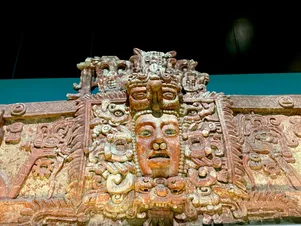
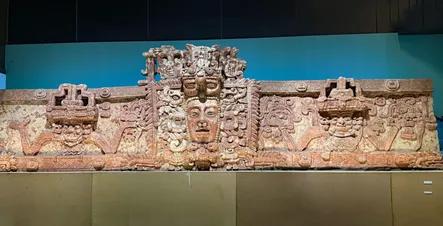
Read the museum's own account of the theft, recovery, and painstaking restoration of the Maya monument.
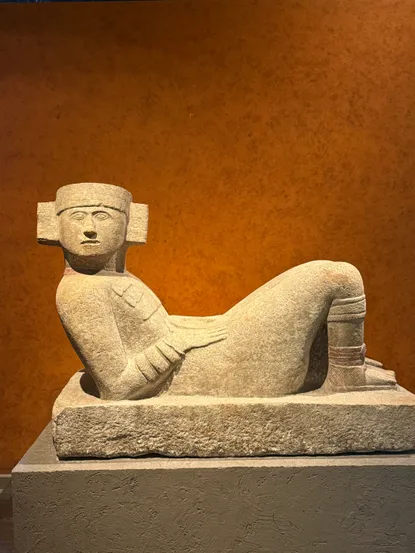
The Chac Mool
I was rather taken with this reclining figure. I had a postcard of almost exactly the same image on my desk for years in my twenties. I never knew what it was, but I liked it. So it was a lovely surprise to come across one in the museum and finally discover its story.
The first Chac Mool of this kind was discovered at Chichén Itzá in 1875 by French-born explorer Augustus Le Plongeon, who was excavating the ruins with his wife, Alice Dixon. He found it on the Platform of the Eagles and Jaguars, and it took twelve days to move the enormous stone sculpture by wooden cart to the nearby village of Pisté.
Le Plongeon had grand plans to take it to the United States, hoping to exhibit it in Philadelphia. But the Mexican authorities had other ideas. In 1877, while Le Plongeon was away, the governor of Yucatán confiscated the sculpture. It was eventually sent to Mexico City and became part of the National Museum's collection, where it remains today.
As for what it actually represents, that's still something of a mystery. Chac Mool figures are generally thought to have served as ritual offering tables. The shallow bowl resting on the figure's stomach may have held offerings to the gods, including, in some cases, human hearts. No one knows for certain whether the figure represents a god, a priest or something else entirely.
When Artists Borrow from the Past
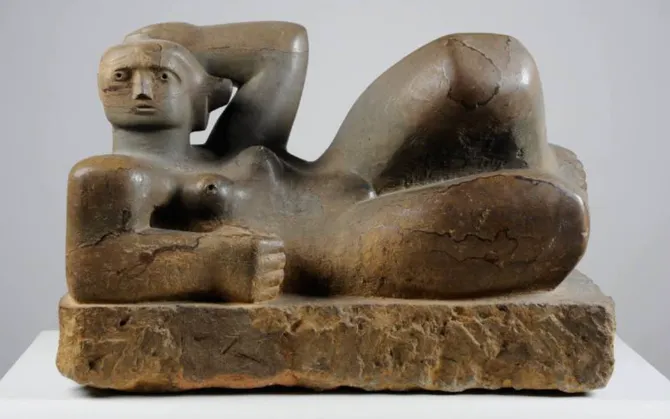
One of the things I love about art is seeing how artists borrow, reinterpret and riff on the work of those who came before them. The Chac Mool is a wonderful example.
The British sculptor Henry Moore was fascinated by this reclining figure. In fact, pre-Columbian Mexican sculpture was such an important influence on his work that he once described it as the single most important influence on his sculpture. He was particularly taken with the Chac Mool's unusual pose, its solidity and the way the figure seems both relaxed and alert.
Moore first encountered it through reproductions and a plaster cast in Paris, but finally made the journey to Mexico in 1953 to see the ancient sculpture for himself.
Pakal: The King Hidden Inside a Pyramid
One of the most extraordinary discoveries in Maya archaeology was made at Palenque, in southern Mexico. In 1952, after months of clearing rubble and uncovering a hidden staircase inside the Temple of the Inscriptions, archaeologist Alberto Ruz Lhuillier finally reached a sealed burial chamber. Inside was the tomb of K'inich Janaab' Pakal, one of Palenque's most important rulers.
Pakal had ruled for nearly 70 years, from 615 to 683 AD. His body lay inside an enormous carved stone sarcophagus, surrounded by jade jewellery and elaborate funerary offerings. Among the treasures was his famous jade mask, assembled from around 200 individual pieces, with eyes made from shell and obsidian.
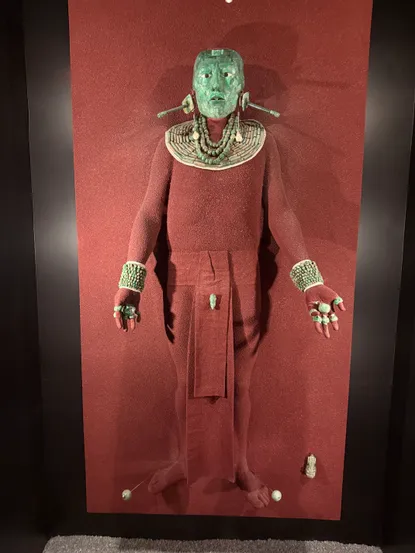
At the museum, you can walk around a reconstruction of the tomb, looking down into the burial chamber and at the intricately carved sarcophagus lid. The atmosphere is wonderfully dark and atmospheric. Nearby, a reconstruction of Pakal's funerary attire gives you an idea of how he would have appeared, dressed in jade and other precious ornaments.
The tomb had remained sealed for more than 1,200 years. Standing there, looking down into it, you get a sense of just how extraordinary that discovery must have been.
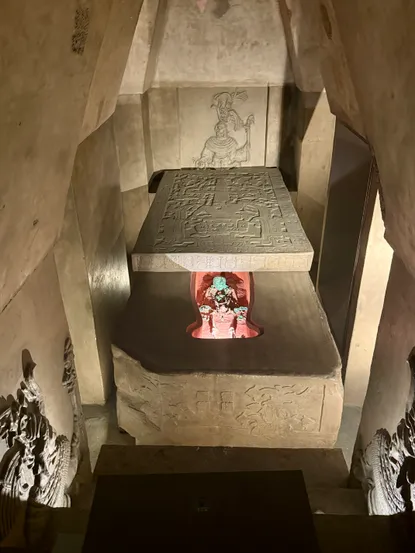
It's worth noting that what you see here is a reconstruction of the tomb and burial scene, rather than the original chamber. The figure dressed in jade ornaments is also a reconstruction of Pakal, but the extraordinary jade funerary mask and jewellery are genuine objects recovered from his tomb. The original sarcophagus and its intricately carved lid remain at Palenque.
Xilonen: The Goddess of Young Maize
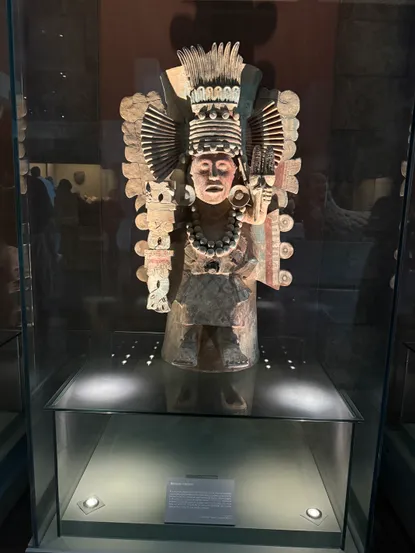
I was drawn to this rather magnificent ceramic figure, a ceremonial brazier depicting Xilonen, the Mexica goddess of young maize. She wears an elaborate feathered headdress and holds ears of corn and a rattle stick, symbols of fertility and the agricultural cycle.
But the story of how she came to be in the museum is almost as interesting as the object itself. On August 3, 1995, a local farmer named Jesús Galindo was working his land in San Pedro Tláhuac, in the south of Mexico City, when he uncovered fragments of what turned out to be five extraordinary ceremonial braziers. Archaeologists were called in, and the pieces were carefully excavated and restored. They date from around 1500 to 1520. In 2001, they were transferred to the National Museum of Anthropology, where they are now displayed in the Mexica gallery.
The five figures represented deities associated with agriculture, maize and water. Xilonen was specifically connected with tender, young maize, while Chicomecóatl represented mature maize. It gives you a sense of just how central corn was to Mexica life. It wasn't simply something to eat. It was bound up with their beliefs, ceremonies and understanding of the natural world.
Their lives depended on the soil, the rain, the seasons and the harvest. They understood the natural world not as something separate from themselves, but as something they were entirely part of. A lovely reminder worth thinking about a little more in today’s world.
The Olmec Colossal Heads: An Ancient Mystery
I love a good mystery, and the Olmec colossal heads are packed with them. Who carved these enormous faces, and who were they meant to represent? Could some have been carved from even older monuments, the work of an earlier generation or civilisation? And perhaps most astonishingly, how did people move blocks of stone weighing many tonnes across difficult terrain, long before modern machinery?
Seventeen colossal heads have been discovered so far, across the Gulf Coast region of Mexico, particularly around San Lorenzo, La Venta and Tres Zapotes. Carved from volcanic basalt more than 3,000 years ago, each has its own distinctive features and elaborate headgear. They are thought to represent important individuals, possibly rulers, although we don't know their identities.
The two displayed here are relatively small compared with some of the others. The largest is estimated to weigh between 40 and 50 tonnes. The basalt came from the Tuxtla Mountains, in Veracruz, in some cases as much as 150 kilometres away. How the Olmec quarried, transported and carved these enormous blocks remains one of archaeology's great engineering puzzles. They may have used rivers and waterways, as well as land routes, but the precise methods are still debated.
And there's another intriguing possibility. Archaeologists have found evidence that some of the heads were actually carved from earlier stone monuments, including large ceremonial thrones. Imagine an old monument being transformed into a portrait of a ruler, perhaps to mark a change in power or honour someone who had died. So even the stone itself may have had a previous life.
I find it extraordinary to stand in front of these faces and think about the people who made them. Their names are lost, but their work has survived for thousands of years.
If, like me, you enjoy a good archaeological mystery, I watched a fascinating YouTube documentary called They Moved 40-Ton Stone Faces Through Jungle, which explores how these extraordinary monuments were made and transported. Well worth watching!
Another one to look out for is The Olmecs: Mesoamerica's Mysterious First Civilization.
Or if you're short on time, a quick reel: https://www.youtube.com/shorts/WRt4IjD4IFY
Information:
The Museo Nacional de Antropología is in Chapultepec Park, on Paseo de la Reforma, close to Polanco.
Address: Av. Paseo de la Reforma and Calzada Gandhi, Chapultepec Polanco, Mexico City.
Opening hours: Tuesday to Sunday, 9 am–6 pm. Closed Mondays.
Admission: MXN $210 for international visitors; MXN $105 for Mexican nationals and foreign residents. Check the official website before visiting, as prices can change.
Allow: At least three hours. You could easily spend half a day here.
A few useful things to know:
- Personal photography is allowed, but no flash, tripods or lights.
- Large bags must be left in the cloakroom or lockers.
- There is a café, restaurant and museum shop.
- Free guided tours are available, subject to guide availability.
Museum website: https://mna.inah.gob.mx/
While You're in the Neighbourhood
The museum sits on the edge of Chapultepec Park and is a lovely starting point for exploring the area. Afterwards, take a walk through the park, visit the lake, or head over to Polanco for lunch, coffee, and a wander around its elegant streets and shops. If you have the energy, Parque Lincoln is a pleasant place to finish the afternoon.